There’s a moment every seasoned art director knows well. The client brief lands on your desk, the deadline is already breathing down your neck, and someone in the room says: “Can we see how this looks in context?”
Before a single layer gets renamed in Photoshop, before the first smart object gets double-clicked — the background decision has already been made. And increasingly, that decision is a Billboard mockup.
But why? What makes professional agencies reach for mockup backgrounds first, treating them not as a finishing touch but as a creative foundation?
The Psychology of Selling Ideas
Clients don’t buy logos. They don’t buy color palettes. They buy feelings — specifically, the feeling of seeing their brand alive in the real world.
A flat design on a white canvas asks clients to imagine. A billboard mockup asks them to react. And reactions close deals far faster than imagination does.
Top agencies figured this out years ago. When you present a campaign concept dropped into a rain-slicked New York street at dusk, the conversation shifts immediately. You’re no longer defending kerning choices — you’re discussing brand presence, visibility, and emotional resonance. The mockup background reframes the entire meeting.
Workflow Logic: Why Background Comes First
Here’s something counterintuitive about professional design workflows: the context often shapes the creative, not the other way around.
When you select your billboard environment upfront — urban rooftop, highway edge, suburban storefront — you’re making decisions that ripple through everything:
- Typography scale — massive outdoor formats demand different hierarchy than digital
- Color contrast — a sun-bleached afternoon scene requires punchy, high-contrast palettes
- Negative space — real-world billboard compositions breathe differently than screen designs
- Mood alignment — a gritty industrial backdrop tells a completely different brand story than a clean city intersection
Choosing the background first isn’t a shortcut. It’s actually better creative thinking — anchoring abstract concepts in physical reality from minute one.
Real-World Applications: Billboard Mockups in Practice
The practical uses of billboard mockups extend far beyond simple client presentations. Here’s where agencies genuinely deploy them:
Pitch decks and proposals — Before a campaign is approved or budgeted, mockups demonstrate outdoor advertising scale and impact without any media spend. Agencies regularly win accounts on the strength of a single compelling mockup slide.
A/B concept testing — Drop two headline variations into the same billboard environment and suddenly stakeholders can evaluate messaging objectively rather than abstractly.
Social media content — Brands frequently use billboard mockups to create aspirational “as seen in the city” content for Instagram and LinkedIn, building perceived scale even for small businesses.
Portfolio building — Junior designers and freelancers use premium mockups to demonstrate outdoor advertising capability without requiring real campaign budgets.
Billboard Mockups on ls.graphics
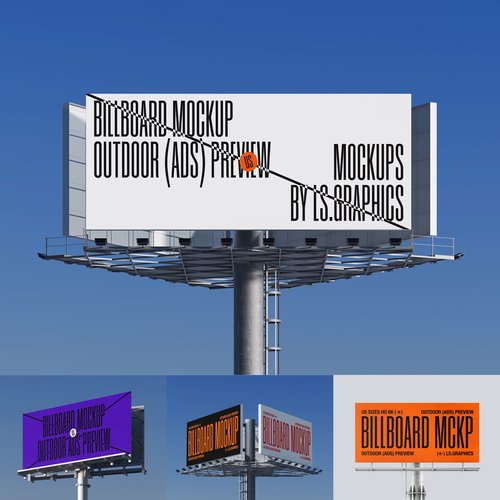
ls.graphics has built a genuinely impressive billboard mockup library that serious designers keep returning to. The renders are ultra-realistic — lighting, shadow, and surface texture behave like actual photography, not CGI approximations. Layers are organized cleanly, making smart object replacement genuinely fast. You get multiple angles per scene, various color styles, and compositions that feel editorially styled rather than generic. The Edit Online feature lets you swap designs directly in the browser — no Photoshop required. And a solid collection of free scenes means you can test quality before committing. For agencies moving fast, this kind of library isn’t a luxury — it’s infrastructure.
The Competitive Edge Nobody Talks About
There’s a quieter reason agencies prioritize mockup backgrounds: it standardizes quality across skill levels.
A junior designer working inside a well-chosen, photorealistic billboard scene produces work that reads at senior level. The environment does heavy lifting. The client perceives polish. The agency maintains its visual standard regardless of who’s executing on a given day.
That’s not cutting corners — that’s intelligent systems design.
Conclusion
The best creative decisions are made early, not late. Choosing your billboard environment before touching type or color isn’t laziness — it’s the discipline of grounding ideas in reality from the start. It changes client conversations, sharpens creative decisions, and makes every presentation land harder.
Tools and libraries like those at ls.graphics exist precisely because professional workflows demand this kind of foundation. The mockup background isn’t where the idea ends. It’s where it begins.
About the Author